Personalized onboarding & search.
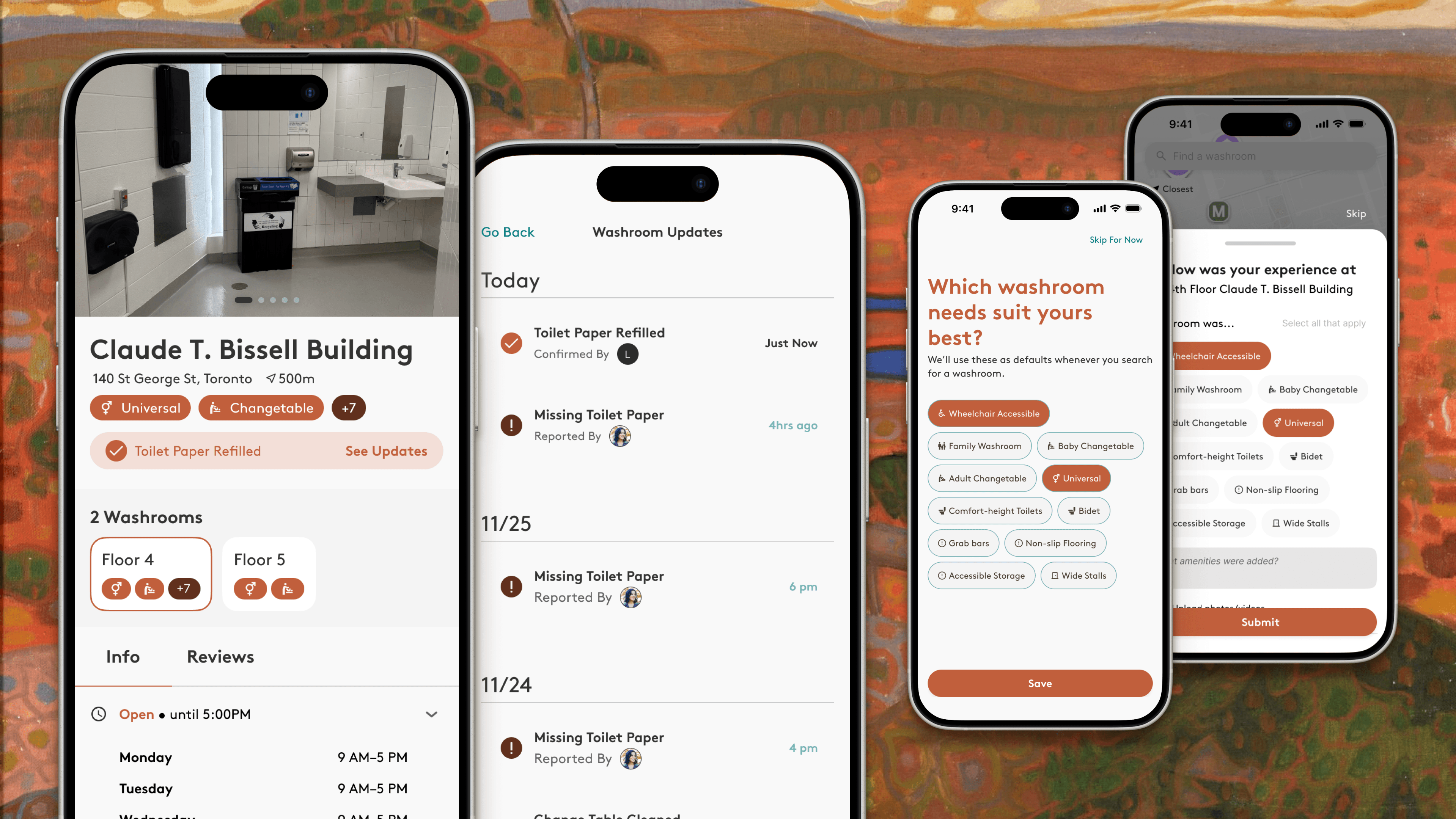
Since the accessibility label didn't always cater to people's needs, GoAble asks users about them during onboarding - then filters results to match their profile.

From research to prototype, this UX design project informs users about washroom access and amenities in real-time, with a focus on personalization, community engagement, and trustworthiness.
I led the development of the design system and the interactive prototypes, using Figma Variables to flesh out interaction insights in our initial designs.
Whether it's Google Maps, or dedicated washroom finding apps like Toilet Finder, washroom listings on the current market lack sufficient .
How do we make washrooms more accessible, when access means something different for everyone?
Since the accessibility label didn't always cater to people's needs, GoAble asks users about them during onboarding - then filters results to match their profile.
Washroom details pages show real-time availability, community sentiment, and granular amenity info so users can make informed decisions before they arrive.

Quick-select, pre-loaded options reduce friction to near zero - making it just as easy to leave a review as it is to skip it.

revealed the different barriers to access people experienced when finding a washroom. It influenced our , tackling three critical issues in washroom finding:
of the accessibility label;
on washroom listings; and
of truth.
Two things kept coming up in the research: people couldn't find the specific details they needed, and even when they could, they didn't trust them. These personas put a face to both of those problems, and shaped everything that came next.
Hover to learn more
Since the didn't always cater to people's needs, we asked users about them during onboarding, influencing the washroom listings suggested during the search.
Washroom details pages show critical information such as amenity offerings, real-time availability or concerns, and community sentiment to help users make .
To validate the status of the washroom, we envisioned a community section that acts as a that users can contribute to, so they can feel confident in their decision making.


GoAble filters washrooms by your needs, surfaces granular details before you arrive, and uses crowdsourced reviews to keep information honest and reduce the stress of finding a suitable washroom in public.
This project taught me that access doesn't just mean physical, but also emotional and political barriers people face.
Instead of maximizing a design through incentives or by providing all options, I learned that people appreciate when designers provide exactly what they need, when they need it, while respecting their choice to participate or not.
The feature I'd build next is in-building wayfinding. We cut it due to time, but it was the one thing our research surfaced that no existing tool handles at all.